Preprint

Amplified Does Not Mean Predictive

Reasoning Behaviors in Thinking Models

Thinking models amplify visible deliberation, but not the behaviors most associated with correct answers.

Language Technologies Institute, Carnegie Mellon University
15,282traces
15models
6benchmarks
9behaviors
2metrics
Overview

We separate behaviors that become frequent from behaviors associated with correctness.

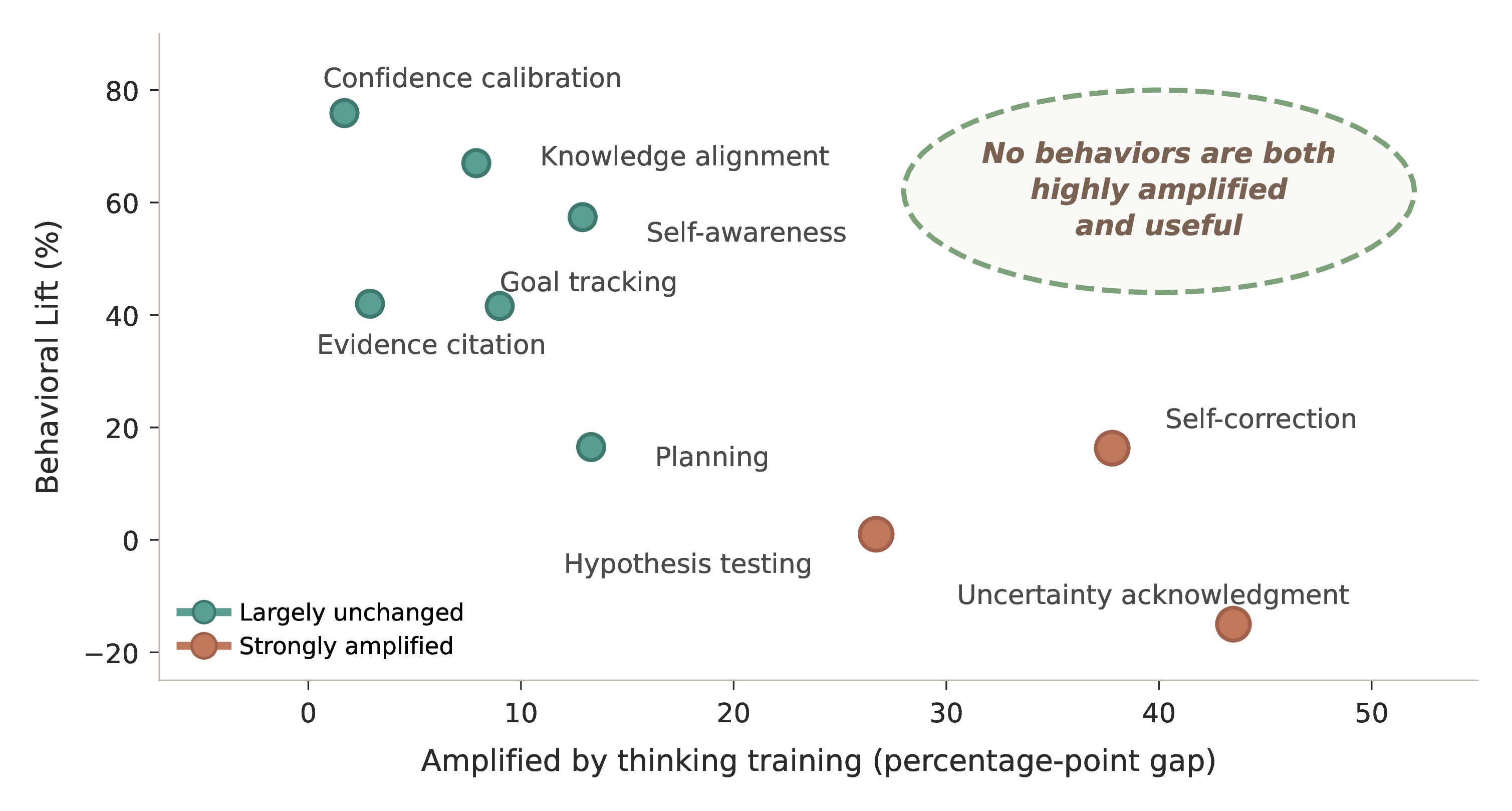
Across 15 open-weight LLMs and VLMs, 6 benchmarks, and 15,282 annotated reasoning traces, we ask whether thinking models amplify the behaviors most associated with correct answers. We find a consistent amplification-lift gap: thinking models strongly amplify self-correction, hypothesis testing, and uncertainty acknowledgment, while the highest-lift behaviors are confidence calibration, knowledge alignment, and self-awareness.

Amplification in thinking models versus Behavioral Lift. The top-right quadrant is empty.
The central mismatch: no behavior is both strongly amplified in thinking models and strongly associated with correctness.
Metrics

Two measurements: association with correctness and recovery after failure.

Accuracy tells us whether an answer is right. These metrics ask what the trace is doing along the way.

Behavioral Lift
Lift(b) = P(correct | b=true) - P(correct | b=false)

Measures how much correctness changes when a behavior appears in the trace. Lift separates prevalence from association with correctness.

Recovery Rate
Recovery = P(correct | any failure=true)

Measures whether a model reaches the correct answer despite a detected reasoning failure.

Taxonomy

Nine core behaviors, defined identically for LLM and VLM traces.

The taxonomy lets us compare language-only and vision-language reasoning using the same behavioral labels.

PlanningBreaks the problem into explicit sub-steps.
Goal trackingTracks progress toward intermediate or final goals.
Hypothesis testingConsiders alternatives, cases, or interpretations.
Self-correctionRevises or corrects a previous step or claim.
Uncertainty acknowledgmentExpresses doubt, ambiguity, or confusion.
Confidence calibrationCertainty tracks the strength of reasoning.
Self-awarenessRecognizes missing information or limits of support.
Evidence citationGrounds claims in prompt evidence or constraints.
Knowledge alignmentUses the appropriate domain facts or framework.
Result 1

Thinking models amplify correction, search, and uncertainty.

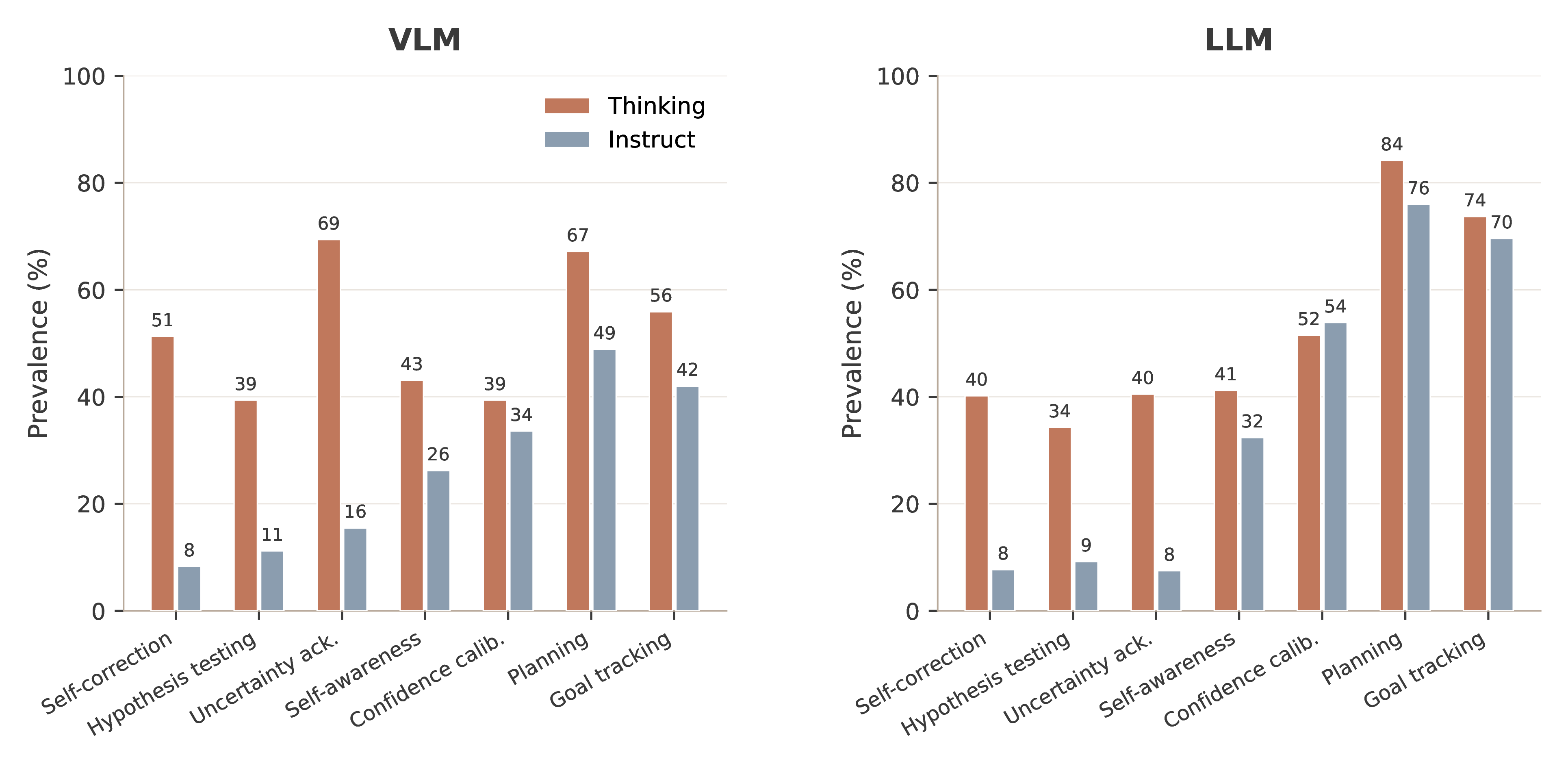
Thinking models produce far more self-correction, hypothesis testing, and uncertainty acknowledgment than instruct models. Confidence calibration and knowledge alignment move much less.

21-55%self-correction in thinking traces
22-52%hypothesis testing in thinking traces
25-85%uncertainty acknowledgment in thinking traces
Aggregate behavior prevalence for thinking and instruct models.
Thinking models selectively amplify visible deliberation: self-correction, hypothesis testing, and uncertainty acknowledgment show the largest prevalence gaps.
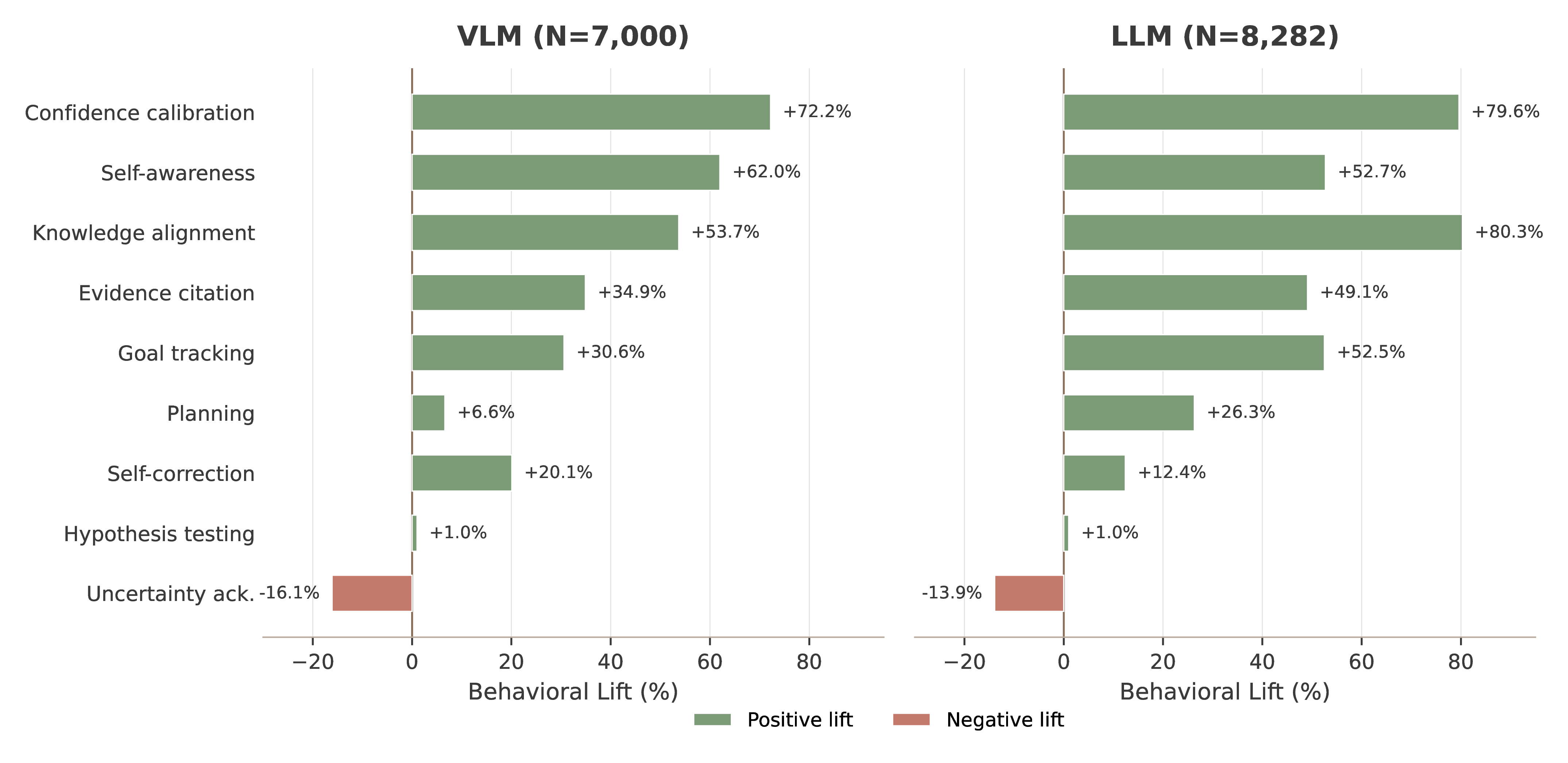
Behavioral Lift ranking for nine behaviors in VLMs and LLMs.
The highest-lift behaviors are different: confidence calibration, self-awareness, and knowledge alignment rank near the top; uncertainty acknowledgment is negative.
Result 2

Amplified behaviors diverge from highest-lift behaviors.

Confidence calibration is the strongest positive signal of correctness in both modalities, but thinking models barely amplify it. Uncertainty acknowledgment is heavily amplified, yet weakly or negatively associated with correctness.

BehaviorVLM LiftLLM Lift
Confidence calibration+72.2+79.6
Knowledge alignment+53.7+80.3
Self-awareness+62.0+52.7
Self-correction+20.1+12.4
Hypothesis testing+1.0+1.0
Uncertainty acknowledgment-16.1-13.9
Robustness

The lift ranking holds across benchmarks.

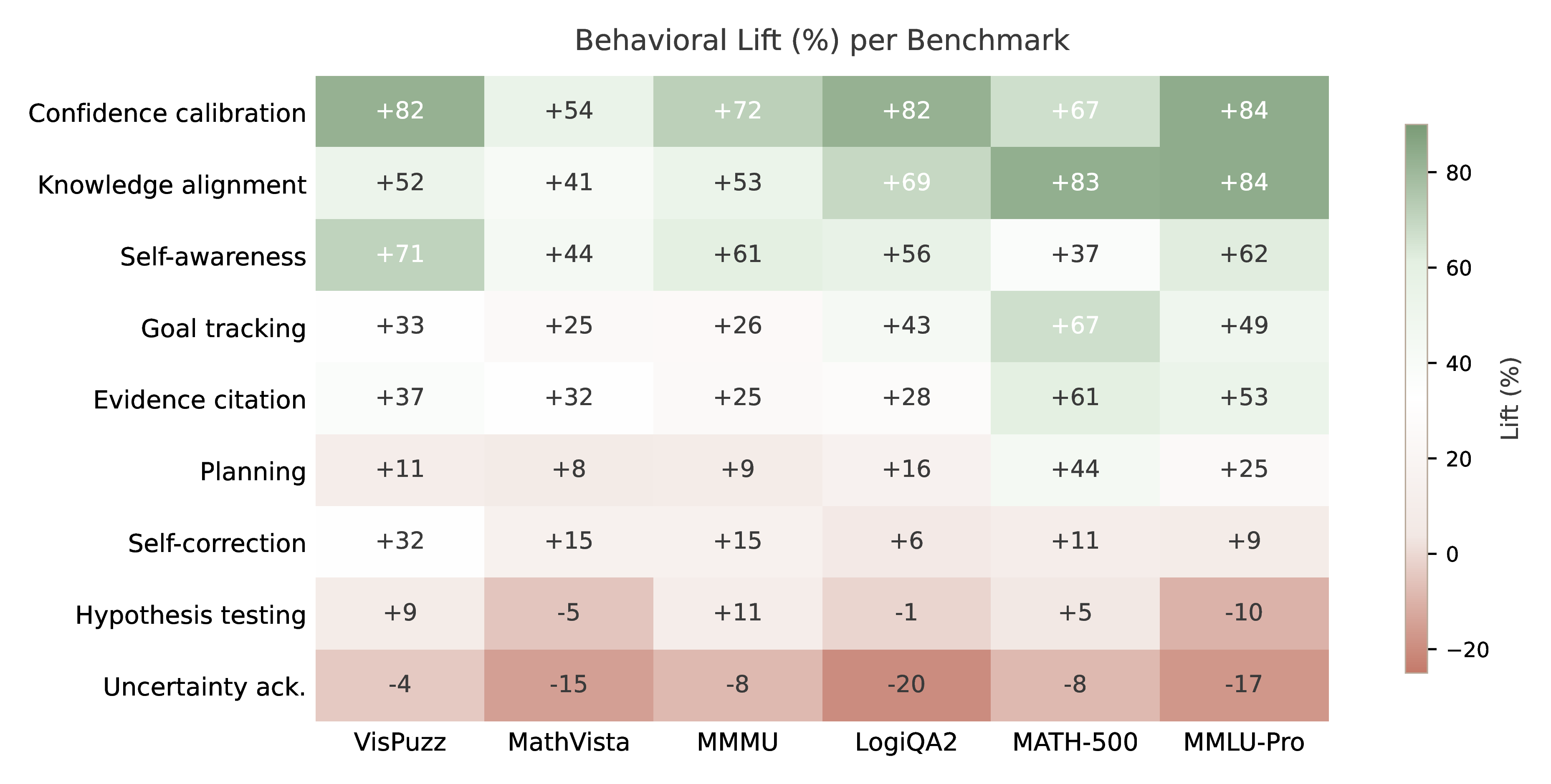
The mismatch survives within individual benchmarks. Confidence calibration and knowledge alignment remain high-lift across tasks, while uncertainty acknowledgment stays low or negative.

We also validate the ranking with same-question controls, manual checks, hidden-state probes, and length controls in the paper.

Behavioral Lift across all LLM and VLM benchmarks.
The same broad ranking appears within benchmarks: high-lift behaviors stay high across LLM and VLM tasks; amplified uncertainty remains low-lift.
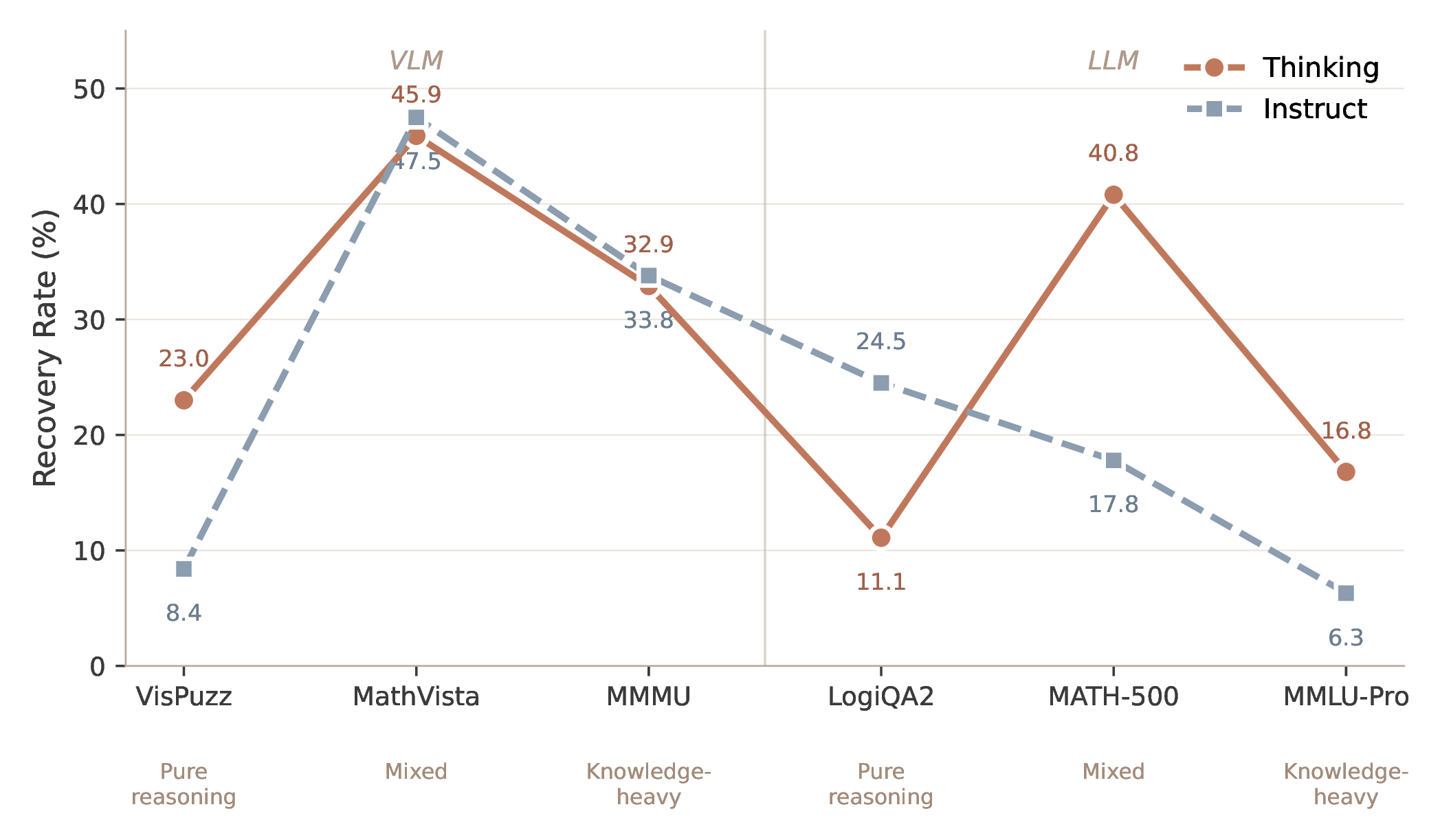
Recovery Rate across six benchmarks for thinking and instruct models.
Thinking helps when recovery matters: thinking models recover better on VisualPuzzles, MATH-500, and MMLU-Pro; instruct models recover better on LogiQA2.
Result 3

Thinking models often win through recovery rather than prevention.

On extended-reasoning tasks, thinking models reach correct answers after detected failures at 2-3x the rate of instruct models. But on LogiQA2, where fast recognition of logical form can be enough, instruct models recover better.

40.8 vs 17.8MATH-500 recovery rate
23.0 vs 8.4VisualPuzzles recovery rate
11.1 vs 24.5LogiQA2 reverses the pattern
Recovery Behaviors

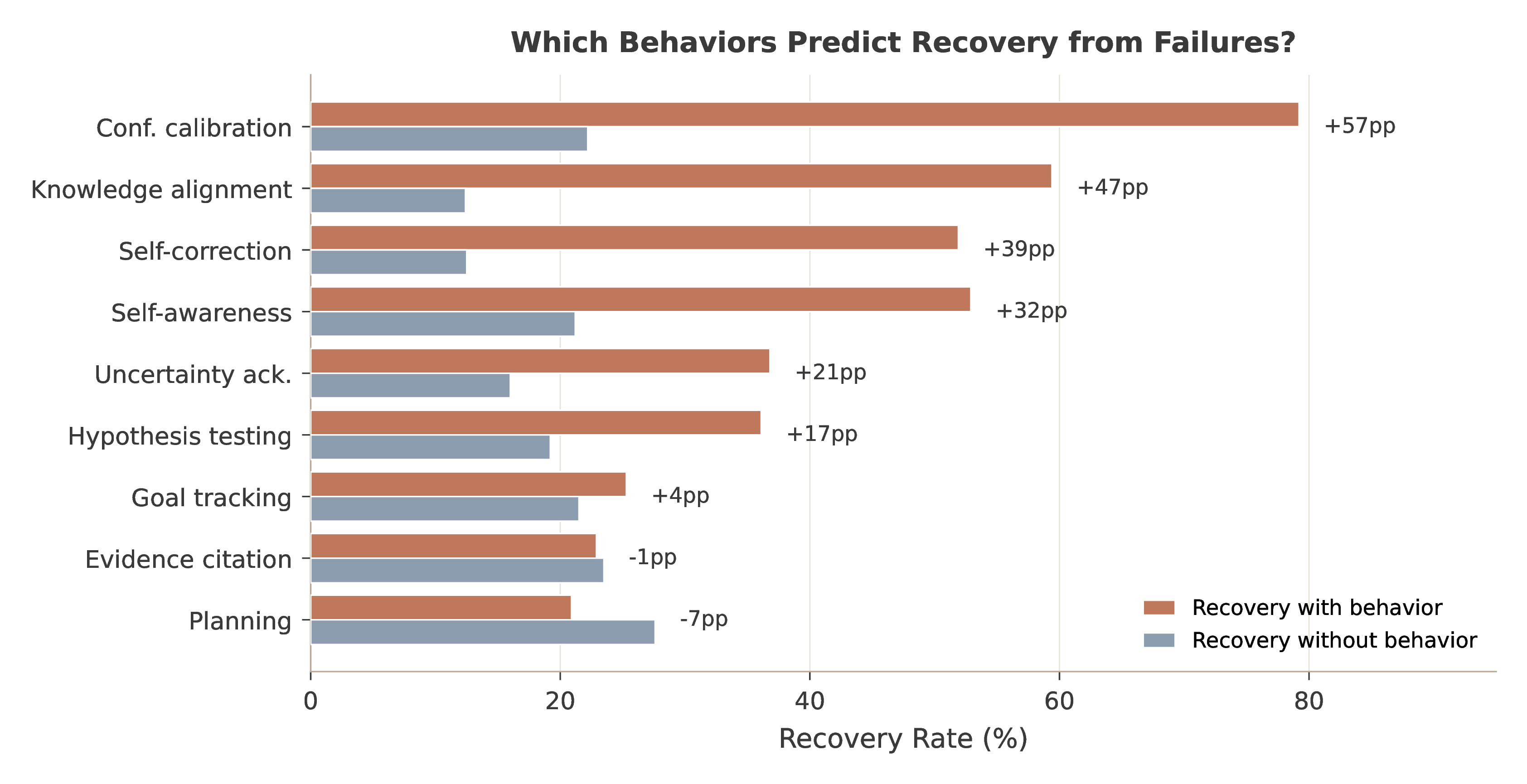
Which behaviors are associated with recovery from failures?

Among traces with at least one detected failure, recovery is highest when the trace shows confidence calibration, knowledge alignment, self-correction, or self-awareness. Some frequent behaviors, including planning and evidence citation, add little recovery signal in this conditional view.

+57pprecovery gap with confidence calibration
+47pprecovery gap with knowledge alignment
+39pprecovery gap with self-correction
Recovery rate conditional on behavior presence among traces with at least one detected failure.
Recovery depends on behavior type: calibration and grounding are associated with recovery after detected failures; planning and evidence citation add little recovery signal.
Scaling

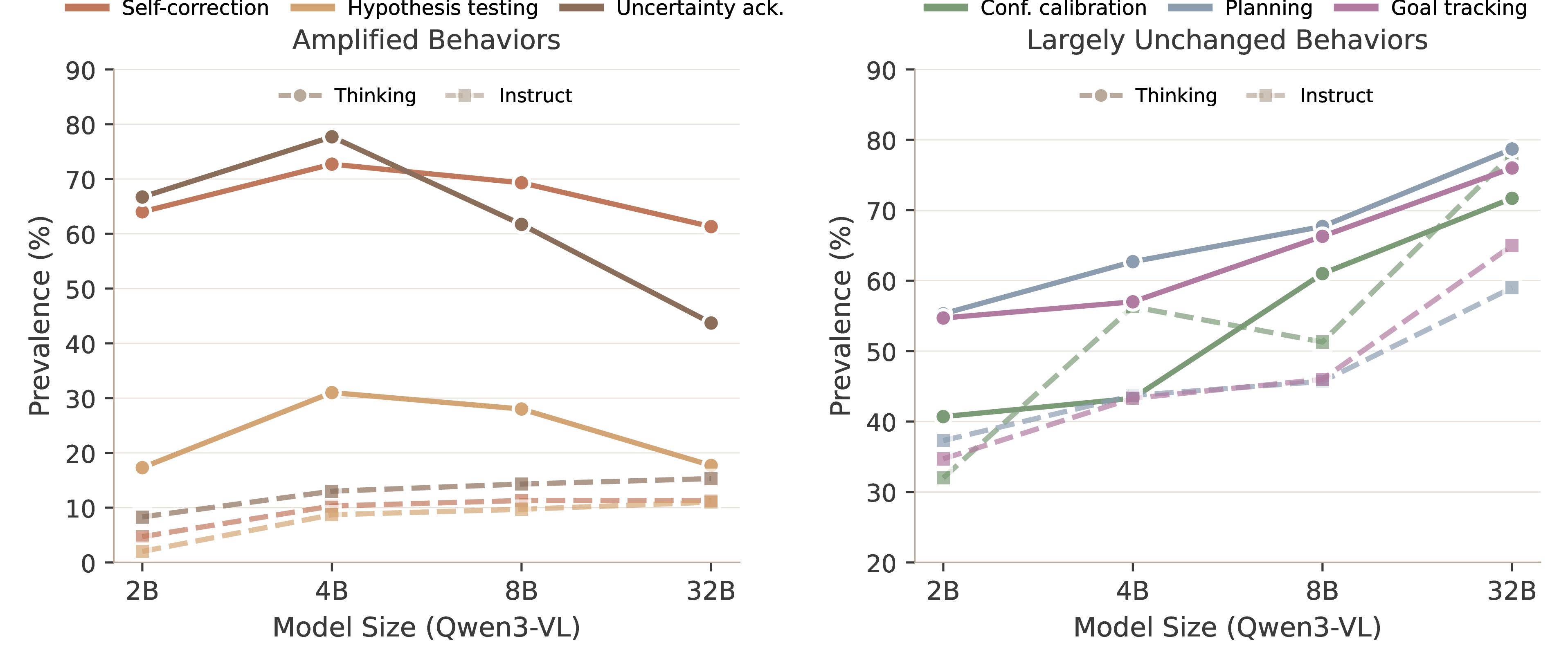
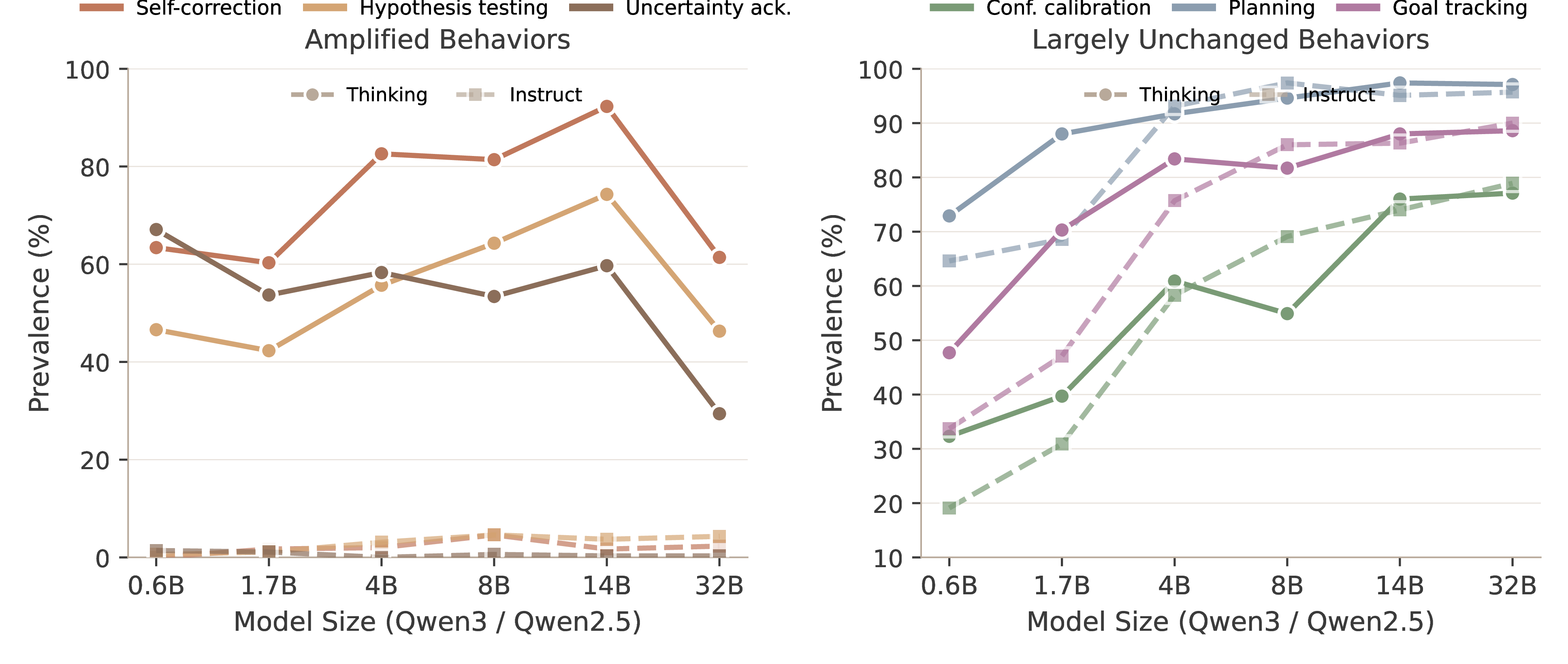
The amplification gap persists at scale.

Larger thinking models still strongly amplify self-correction and uncertainty behaviors. Meanwhile, confidence calibration narrows across model types and remains high-lift across model sizes.

Scaling analysis for Qwen3-VL thinking and instruct models.
VLM scaling: the Qwen3-VL amplification gap persists from 2B to 32B.
Scaling analysis for Qwen-family language models.
LLM scaling: Qwen-family language models show the same broad pattern on MATH-500.
Trace Examples

Calibration and uncertainty leave very different fingerprints in a trace.

A calibrated trace becomes more confident when independent checks agree. A visibly uncertain trace can still fail when doubt never resolves into better reasoning.

Confidence Calibration
Correct

Confidence rises after converging checks.

Question: If 40 calories is 2% of a person's daily requirement, what is the full daily requirement?

The trace solves 0.02x = 40, giving x = 2000.

It then checks the result in percentage terms: 1% is 20, so 100% is 2000.

Both methods give me 2000. That makes me more confident.

OLMo3-7B-Think · MATH-500 · Doc 38
Uncertainty Acknowledgment
Incorrect

Visible doubt still ends in the wrong answer.

Question: A skater starts facing north and spins 2250 degrees to the right. Which direction is she facing?

The trace reduces 2250 degrees modulo 360 and identifies a 90-degree remainder.

It first maps that turn incorrectly, then reconsiders: "Wait, I think I might be confused... If you start facing north and turn clockwise 90 degrees, you face east."

The doubt is explicit, but the trace still settles on west. The ground truth is east.

Qwen3-4B-Think · MATH-500 · Doc 97
Takeaways

Train and evaluate the behaviors that make reasoning reliable.

Use thinking models where they help, then audit which behaviors their traces reward.

Separate prevalence from lift.

A trace feature can become common after reasoning-oriented training while adding little correctness signal. Check whether correctness actually changes when it appears.

Distinguish calibration from hedging.

Uncertainty language alone cannot make a trace reliable. Useful uncertainty tracks evidence: confidence should rise and fall with the strength of the reasoning.

Report how thinking helps.

Thinking can help by preventing failures, recovering from them, improving calibration, or changing shortcuts. Accuracy alone hides these mechanisms.

Audit process objectives.

Process supervision should reward grounded claims, appropriate domain framing, recognition of underspecified information, and recoverable reasoning instead of deliberative surface form alone.

Resources

Paper, code, annotations, and prompts.

We release the behavioral annotations, taxonomy definitions, judge prompts, and metric code for computing Behavioral Lift and Recovery Rate.

@article{nyandwi2026amplified,
  title  = {Amplified Does Not Mean Predictive: Reasoning Behaviors in Thinking Models},
  author = {Nyandwi, Jean de Dieu and Mathur, Leena and Bisk, Yonatan and Neubig, Graham},
  year   = {2026}
}